One fall, four plans
The easiest way to see how the letters differ is to follow a single accident. Imagine a retired Bel Air cyclist who slips on the Ma and Pa Trail, goes to the emergency room, is treated and sent home, then sees an orthopedic specialist in Baltimore twice and does a round of physical therapy. Original Medicare pays most of it, but it leaves a share behind: the Part B deductible, then 20 percent of each approved charge, with no yearly ceiling on that 20 percent.
Here is how each plan treats that same episode.
| Piece of the bill | Plan A | Plan N | Plan G | Plan F |
|---|---|---|---|---|
| Part B deductible ($292 in 2027) | You pay | You pay | You pay | Plan pays |
| 20 percent of the emergency room bill | Plan pays | Up to $50 copay to you | Plan pays | Plan pays |
| 20 percent of the specialist visits | Plan pays | Up to $20 copay at some visits | Plan pays | Plan pays |
| A bill above Medicare's approved amount | You pay | You pay | Plan pays | Plan pays |
| A hospital admission, if the fall needed one | You pay the $1,776 Part A deductible (2027) | Plan pays it | Plan pays it | Plan pays it |
The pattern is easy to spot. Plan A is a floor, Plan N trades small copays for a lower premium, and Plan G and Plan F leave you with nothing beyond the Part B deductible or, in Plan F's case, nothing at all. Because the Part B deductible resets every January, it is a yearly expense on every letter except Plan F.
Plan A: a floor under the big bills
Plan A pays Part B coinsurance, hospital coinsurance once your Part A days run out, the first three pints of blood and hospice coinsurance. It leaves the Part A deductible, skilled nursing facility coinsurance, the Part B deductible, excess charges and foreign travel emergencies with you.
Its premium is usually the lowest of the standard letters. It tends to attract people who want protection from the open ended 20 percent and are willing to cover the larger fixed costs themselves. The hospital deductible is the piece to think about most.
Plan N: a small copay in place of a bigger premium
Plan N matches Plan G on the big items, including the Part A deductible, skilled nursing facility coinsurance and foreign travel emergency care. The swap is in Part B: instead of paying every coinsurance dollar, it asks you to chip in, up to $20 at some office visits and up to $50 for an emergency room visit that does not end in a hospital admission. Plan N also does not pay Part B excess charges.
An excess charge is the amount a provider who does not accept Medicare's approved amount may add, capped at 15 percent above it. Most providers do accept it, so these charges come up rarely, but it is worth asking your doctors. Plan N tends to suit people who visit a doctor a few times a year and prefer small, occasional copays to a higher monthly bill.
Plan G: one yearly deductible, then covered
Plan G adds the full Part B coinsurance and 100 percent of excess charges to everything Plan N covers. The only cost left is the Part B deductible, $292 in 2027. Once you have paid it, covered care costs nothing more until January, other than your premium.
Plan G is a frequent starting point for people who see specialists regularly, expect a procedure or want a steady budget. The price of that steadiness is a premium that is usually higher than Plan N's.
Plan F: open only to people eligible before 2020
Plan F covers every item on the chart, including the Part B deductible. A federal law change closed it to anyone who first became eligible for Medicare on or after January 1, 2020. If you were eligible earlier, you may still buy it. If you were not, Plan G is the closest match, and the Part B deductible is the only difference.
Anyone who already has Plan F can keep it. Moving away is rarely necessary, and it should only be done after talking with us so that no gap in coverage opens up.
Our plan letter chart
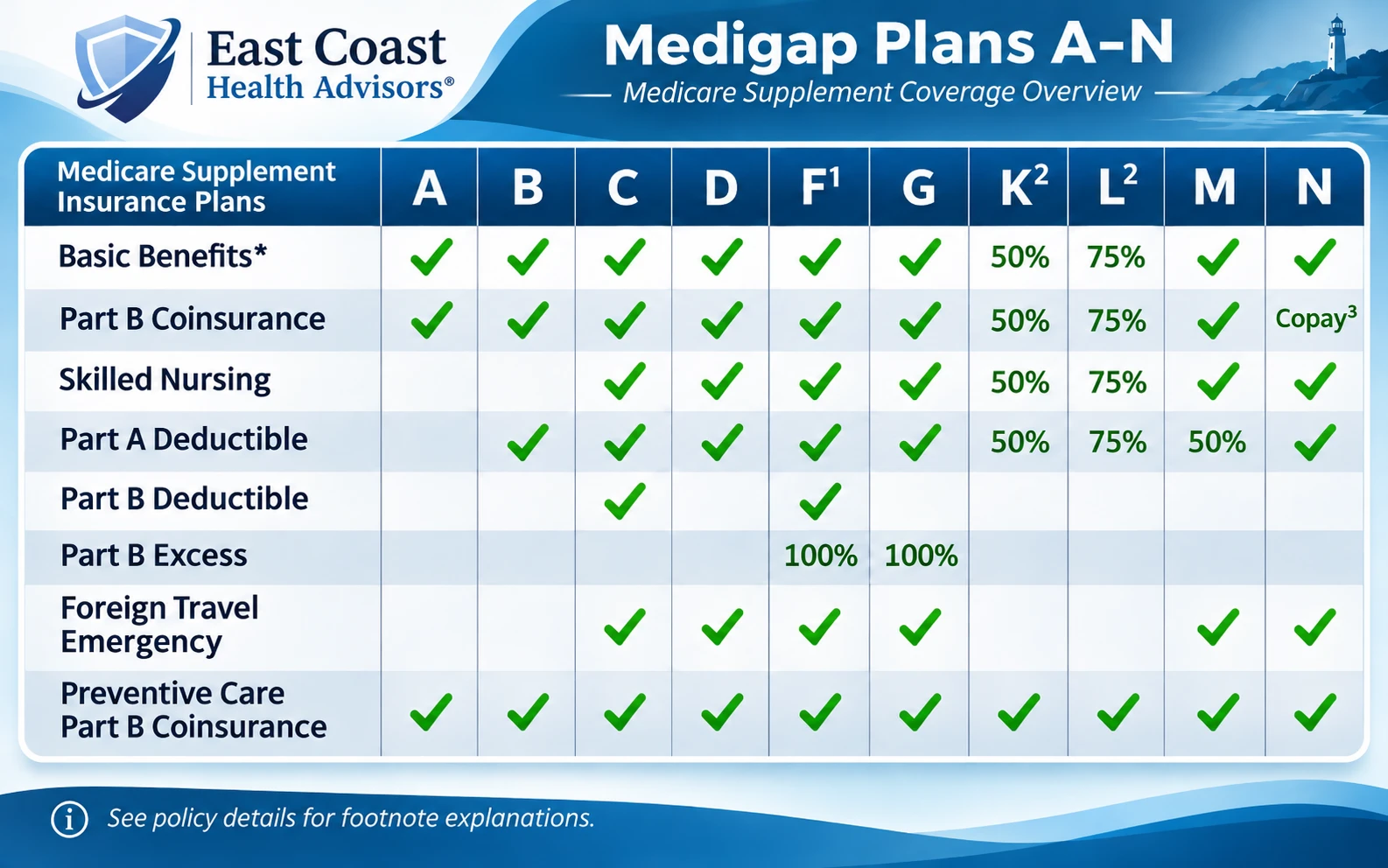
Federal rules fix what each letter pays. If two carriers both sell Plan G in Harford County, the coverage is the same on paper, which leaves service and price to tell them apart. The chart below shows every letter, including K, L and M.
What this means in Bel Air
Harford County residents often split their care between Bel Air and Baltimore, roughly 27 miles apart by road. With a Supplement plan, that split costs nothing extra, because any doctor or hospital that accepts Medicare is open to you. For the facilities close to home, see our Bel Air hospitals and urgent care page.
Once a letter looks right, timing is the next question. Our page on your enrollment windows explains when carriers must accept you whatever your health. Premiums are not listed here because they depend on your age and the carrier, and rates can change without notice.
No savings promises. Which plan costs you less over time depends on your health, your age and how often you use care. Results vary by person.
Unsure which letter is yours?
Call us on (410) 896-1212 and we will walk through the letters with you, using your doctors and your budget. There is no cost for our help.